
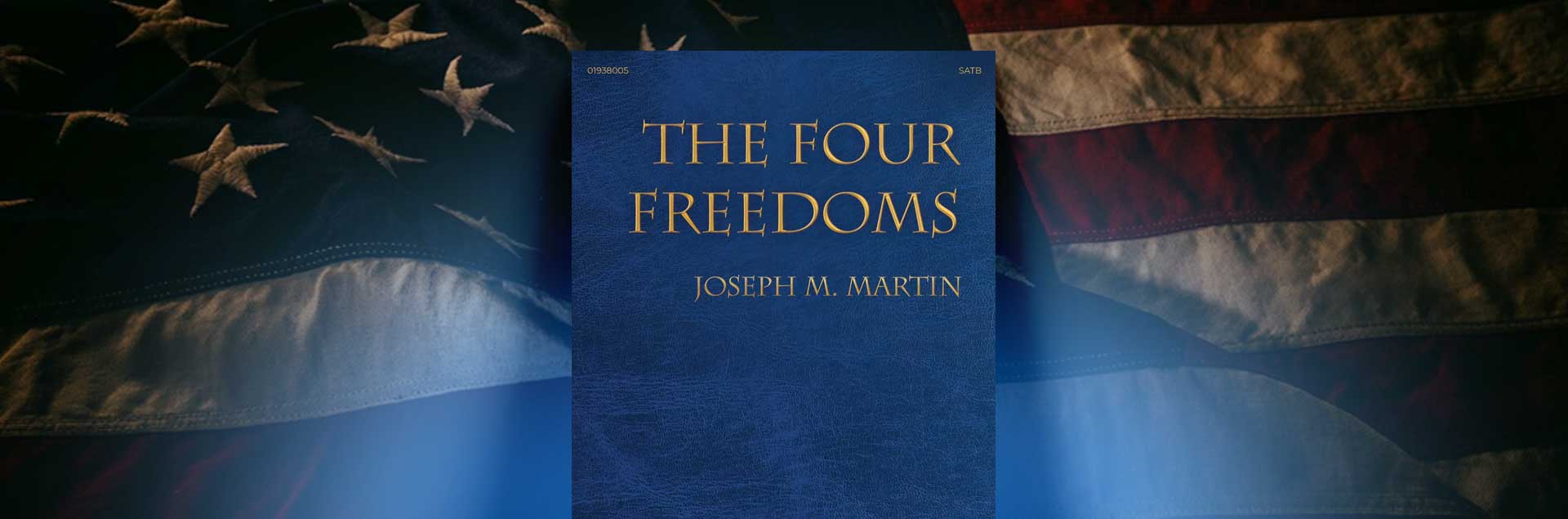
Joseph Martin’s “The Four Freedoms”: Exploring the American Principles of Liberty Through Music
When I first encountered “the four freedoms,” it was through the celebrated quartet of paintings by Norman Rockwell. For me, these amazing masterpieces represented the ideals of artistic beauty mingled with a meaningful message. The noble concepts of “freedom of speech, freedom of worship, freedom from want, and freedom from fear” are simple yet profound ideas to ponder. And as you linger with them, you realize they are foundational to people everywhere.
During my student days, I did some research on these paintings and discovered that the four freedoms were first articulated by President Franklin D. Roosevelt in a speech to the U.S. Congress. Amid the chaos of a world war, the simplicity illustrated by these four foundational freedoms offered hope and wisdom to a world unsettled by political and economic turmoil.
During the decades since, these ideals for democracy have become a treasured addition to the dreams of freedom seekers the world over. They inspired the four paintings by Rockwell—and when those incredible paintings found me, so did their message. For many years I had pondered putting music to this majestic message of liberty.
2026 marks the 85th anniversary of Roosevelt’s important speech. It also marks the 250th birthday of the United States of America. This inspiring intersection, along with an invitation to perform at Carnegie Hall, became the catalyst for me to start composing after many years of consideration.
While lingering with “the freedoms,” I discovered that these essential rights are meant for all people. That inherent in their spirit is a truth that transcends the many borders that often separate us.
In crafting the lyrics for the work, I intentionally conveyed the concept that when claiming these freedoms, we also take on their responsibilities.
In the “freedom of speech” movement called The Voice, I suggested that with the granting of this freedom, we are also challenged with the responsibility to listen. This approach reminds us that when we live in a free society, we must also strive to protect the sacred freedoms of others.
There’s a stirring in the soul,
A sacred urging from above,
A noble quest, a worthy goal
A dream to speak my truth in love.
When I wrote these lines, I was thinking of Rockwell’s portrait of the humble working man standing and speaking in a town hall meeting as others listened to his truth. If you look deep enough, you may notice that the man bears an uncanny resemblance to Abraham Lincoln. Rockwell’s common-man archetype was perfectly displayed with a model that brought to mind the image and ideals of Lincoln.
In the “freedom of worship” movement called The Gathering, I used two early American hymn tunes to represent the spirit of the sacred and the joy we celebrate when we come together to worship and praise. This movement joins two hymns, Brethren, We Have Met to Worship and How Firm a Foundation, first separately and then as a partner song with both tunes being sung at the same time. This was done to illustrate that though we are many voices, we are one choir. Our differences can actually make harmony when joined together by the spirit of community.
The third movement, Sanctuary, represents “freedom from fear.” Considering the circumstances of Roosevelt’s speech, this movement takes on a very dramatic musical soundscape. It suggests the conflict of war and contrasts the encouragement to “be not afraid” with the reality of a world filled with fear.
Be not afraid when war resounds,
When battles rage and hate abounds,
When hostile nations shout and scream
And threaten every noble dream.
But then comes an encouragement that sings healing…
Be strong, your fears release,
And to the violence whisper peace.
Rockwell reaches deep into our hearts with his imagery. His painting shows two parents tucking their children into bed. The father holds a newspaper with a headline announcing war. The imagery and contrast found in this painting are deeply moving.
The fourth movement is called Assurance, representing “freedom from want.” This movement was challenging for me! Then I remembered the 23rd Psalm and its ability to celebrate riches that are beyond our usual definitions of wealth and status. While composing this movement, I recalled the Shaker song Simple Gifts and decided to include it because of its quintessential musical spirit and because its lyrics define the truly important values in life. I wrote an original last stanza that wraps this core value up in a bow:
Oh, love is the greatest gift of all
A rose that never fades
All those who know its sacred call
Are blessed a thousand ways.
Rockwell included himself and many of his friends and neighbors in this famous painting that suggests a Thanksgiving meal. As I was writing, this detail reminded me to put myself and my loved ones into the message of these freedoms. Like Rockwell, when we make these values personal, it changes our perspective and ministers to our conscience.
One day, when surveying a special exhibition of these masterpieces in New York, I paused and noticed the frames that held the paintings. Simple, sincere, and honest, they seemed modest yet respectful cradles for such profound imagery. Basic wooden arms holding a message that could change the world. Artistry, ministry, and history!
Then it occurred to me that our music is just a frame—a modest window for others to pause and consider the beauty and truth of something truly significant. As we present The Four Freedoms, let us build our frames of performance from a place of humble gratitude. Let the power of this noble message change you as it has changed me. Then, with confidence and conviction, stand tall, breathe deeply, and share your truth in love.
Find your voice and let freedom sing!
/https%3A%2F%2Fjwpepper.vtexassets.com%2Farquivos%2Fids%2F3039895%2Fcovers-11642095.jpg%3Fv%3D639009846776200000)

Mr. Martin, “The Four Freedoms” looks like a wonderful piece of music, and I hope I get to sing it someday. It is always fascinating to hear an artist explain his or her thought process as he worked.
“The Four Freedoms” are among my favorite works of art…my sister has large framed prints in her home, and I have looked at them frequently.
Based on what you have written here, I think you perfectly nailed “Freedom From Fear”, “Freedom of Religion”, and “Freedom of Speech”. But I don’t think you quite found the handle on “Freedom From Want”. I know it’s cliche, but if I had written the music I think I would have leaned into the Thanksgiving theme, possibly with a medley of Thanksgiving-related hymns like “We Gather Together”, “Now Thank We All Our God”, and “Come, Ye Thankful People, Come”.
But “The Four Freedoms” sounds like an excellent choral arrangement, and I hope I get to sing it, or at least hear it, someday.
Thank you for reading and sharing your thoughts, Bernard!